
Letters of Administration Malaysia – Process, Cost & Lawyer
When a person passes away without leaving a valid will, the deceased’s assets cannot simply be taken over or distributed by family members. Even where the beneficiaries are known and there is no family dispute, someone must first obtain the proper legal authority to deal with the deceased’s estate.
In Malaysia, one of the principal ways of obtaining this authority is through an application for Letters of Administration.
Letters of Administration is a legal grant authorising a person, known as the administrator, to collect, manage and administer the assets of a deceased person who died without a valid will. Depending on the circumstances and the appropriate legal route, an application may be made through the High Court of Malaya.
The Law Chambers of Gurvin assists families with Letters of Administration applications in Malaysia, including applications involving property, bank accounts, shares, investments and other assets. We can advise on the appropriate legal procedure, proposed administrator, beneficiaries, supporting documents, administration bond and surety requirements, and prepare the necessary court documents for the application.
If you are unsure whether you require a Letter of Administration, Small Estate application or another procedure, it is important to determine the correct route before filing an application.

What Is a Letter of Administration in Malaysia?
A Letter of Administration in Malaysia is a legal grant authorising an administrator to deal with the estate of a deceased person.
It is commonly required when a person dies intestate, meaning without leaving a valid will appointing an executor who can obtain a Grant of Probate.
Before the grant is obtained, being the deceased’s spouse, child or other next of kin does not by itself give that person unrestricted legal authority to transfer or distribute the deceased’s assets.
For example, the deceased may have left:
- a house, condominium or land;
- money in bank accounts;
- fixed deposits;
- shares and investments;
- vehicles;
- business interests; or
- other assets registered in the deceased’s name.
Banks, land authorities and other institutions may require the appropriate grant or order before allowing the person administering the estate to deal with those assets.
The grant of Letters of Administration therefore provides the administrator with the legal authority necessary to administer the estate, subject to Malaysian law and the terms of the grant.
When Are Letters of Administration Required in Malaysia?
Letters of Administration are generally relevant where a person dies without a valid will and an administrator needs legal authority to deal with the deceased’s assets.
Common situations include where:
- the deceased did not make a will;
- a property remains registered in the deceased’s name;
- the deceased maintained bank accounts or fixed deposits;
- shares or investments need to be dealt with;
- institutions request a grant before releasing assets;
- there are several beneficiaries;
- the estate contains substantial assets;
- an administrator needs to be legally appointed; or
- the circumstances require an application to the High Court.
However, not every person who dies without a will requires a High Court Letters of Administration application.
Depending on the value and nature of the assets and other circumstances, another procedure such as the small-estate procedure administered through JKPTG may be available.
For this reason, one of the first steps should be to identify the deceased’s assets and determine which legal route applies.
What Happens When Someone Dies Without a Will in Malaysia?
When a person dies without a valid will, this is generally known as dying intestate.
A common misconception is that the deceased’s assets automatically become the property of the spouse or children. The beneficiaries’ entitlement to inherit and the legal authority to administer or transfer assets are separate issues.
For example, a deceased person may have a house registered solely in his or her name. The family cannot simply change the registered ownership because they have agreed among themselves who should receive the property.
Similarly, a bank may freeze an account after learning of the account holder’s death and require appropriate legal documentation before releasing the funds.
The family therefore needs to determine:
- what assets and liabilities the deceased left;
- who the lawful beneficiaries are;
- who should act as administrator;
- which estate procedure applies; and
- what grant or order must be obtained before the assets can be dealt with.
Where the High Court route is appropriate, this may involve an application for Letters of Administration in Malaysia.
If there is no will, probate does not apply. The correct legal process is Letters of Administration.
Letters of Administration vs Grant of Probate
Letters of Administration and Grant of Probate are often confused, but they are not the same.
The basic distinction is:
| Situation | Usual Grant |
|---|---|
| Deceased left a valid will appointing an executor | Grant of Probate |
| Deceased died without a valid will | Letters of Administration |
A Grant of Probate confirms the authority of the executor appointed under the deceased’s will.
A grant of Letters of Administration, on the other hand, appoints an administrator where there is no executor capable of obtaining probate, most commonly because the deceased died intestate.
If the deceased left a valid will, you may refer to our Probate Lawyer in Malaysia page for information on the Grant of Probate process.
Who Can Apply for Letters of Administration in Malaysia?
One of the important issues in applying for Letters of Administration is deciding who should be appointed as administrator.
Depending on the circumstances, persons who may have an interest in applying can include the deceased’s:
- spouse;
- children;
- parents; or
- other persons entitled in the estate.
However, it should not be assumed that any relative can automatically apply.
The appropriate applicant can depend on matters such as the deceased’s family structure, the persons entitled to the estate, whether another person has a prior or equal right to apply, whether beneficiaries consent, and whether any beneficiary is a minor.
Where several family members are involved, the application should be structured properly from the beginning.
A Letters of Administration lawyer in Malaysia can review the family structure before the court documents are prepared and advise on the appropriate proposed administrator or administrators.
How Long Does Letters of Administration Take in Malaysia?
The timeline depends on:
Number of beneficiaries
Completeness of documents
Bond and surety requirements
Court schedule
On average, a Letters of Administration application may take several months, and complex estates may take longer.
Can There Be More Than One Administrator?
Yes.
Depending on the circumstances, more than one administrator may be appointed or required.
This can become particularly relevant where there are:
- minor beneficiaries;
- several persons with an interest in the estate;
- complicated family circumstances; or
- other legal requirements affecting the appointment.
The number and suitability of administrators should therefore be considered at the beginning of the application rather than after the court documents have already been prepared.
How to Apply for a Letter of Administration in Malaysia
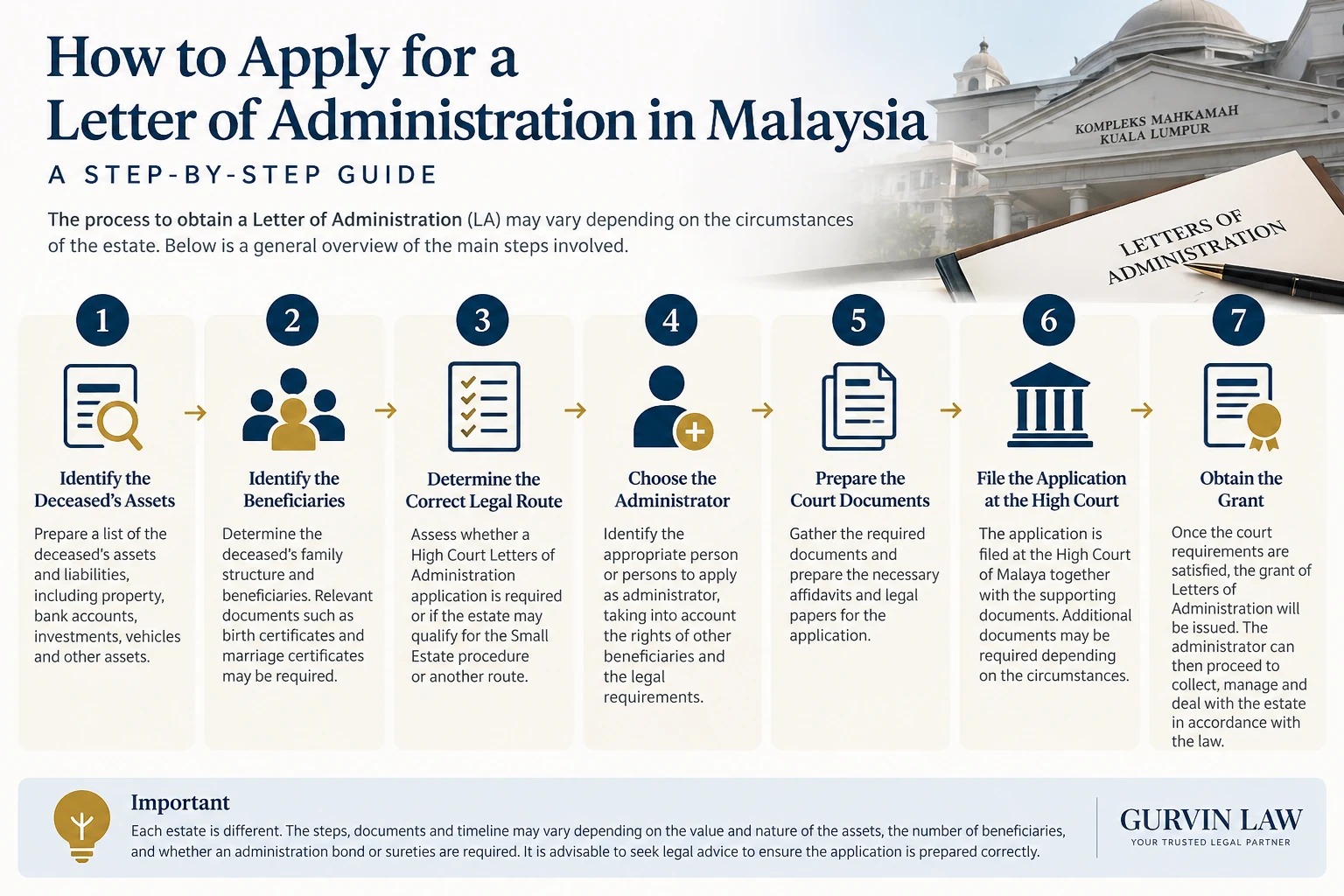
People frequently ask how to apply for a Letter of Administration in Malaysia.
Although each estate is different, a High Court application generally involves several important stages.
Step 1 – Identify the Deceased’s Assets
The family should first prepare a reasonably complete list of the deceased’s assets.
This may include:
- properties and land;
- bank accounts;
- fixed deposits;
- shares;
- investment accounts;
- vehicles;
- business interests; and
- other valuable assets.
Liabilities should also be identified.
This initial exercise is important because the composition and value of the estate may affect which legal procedure is appropriate.
Step 2 – Identify the Beneficiaries
The deceased’s family structure must then be established.
Relevant documents may be required to establish relationships between the deceased and the persons claiming an interest in the estate.
This is particularly important where there are several children, a surviving spouse, surviving parents, deceased beneficiaries, minors or more complicated family circumstances.
Step 3 – Determine the Correct Legal Route
Before proceeding with an application for Letters of Administration Malaysia, it is important to establish whether a High Court application is actually the appropriate route.
Depending on the circumstances, an estate may potentially fall within the small-estate procedure or another available procedure.
Using the wrong procedure can result in unnecessary expense and delay.
Step 4 – Determine the Proposed Administrator
The appropriate person or persons to apply as administrator must be identified.
Where other persons have an equal or prior entitlement to apply, additional documentation, consent or other procedural steps may be necessary depending on the circumstances.
Step 5 – Prepare the Court Documents
Once the relevant information has been gathered, the necessary legal documents for the Letters of Administration application can be prepared.
The documents required will depend on the facts of the estate.
Accuracy is particularly important because inconsistencies relating to beneficiaries, assets, names or family relationships can cause queries and delays.
Step 6 – File the Application in the High Court
Where the High Court has been identified as the appropriate route, the application and supporting documents are filed with the High Court of Malaya.
Further documents or clarification may be required depending on the circumstances of the case and court requirements.
Step 7 – Deal With Administration Bond and Sureties
An application for Letters of Administration may involve an administration bond and sureties.
This is an important difference between some Letters of Administration applications and straightforward probate applications.
Whether sureties are required, who can act as surety, and whether any application concerning the surety requirement is appropriate will depend on the circumstances.
Step 8 – Obtain the Grant
Once the court requirements have been satisfied, the court may issue the grant of Letters of Administration.
The administrator then has the legal authority conferred by the grant to proceed with the administration of the deceased’s estate.
Obtaining the grant, however, is not necessarily the final step. The administrator must still deal properly with the assets and liabilities of the estate.
Documents Required for Letters of Administration in Malaysia
The precise documents required vary from case to case.
As a starting point, documents and information commonly relevant may include:
- deceased’s death certificate;
- deceased’s identity documents, where available;
- applicant’s identification documents;
- marriage certificate, where relevant;
- birth certificates or other evidence of family relationships;
- details of all beneficiaries;
- property titles or property information;
- bank statements or account information;
- fixed-deposit information;
- share or investment statements;
- vehicle information;
- details of liabilities;
- information on the estimated value of assets; and
- other documents relevant to the estate.
Additional documents may be necessary depending on the deceased’s circumstances and the requirements of the particular application.
It is useful to identify missing documents early. Waiting until after the application has begun to resolve discrepancies in names, family relationships or asset ownership can delay the process.
What Is an Administration Bond?
An administration bond is an important issue that may arise in a Letters of Administration application.
Broadly, the bond is intended to secure the proper administration of the estate by the administrator.
Depending on the applicable requirements and circumstances of the estate, sureties may also be required.
Families are sometimes unaware of this requirement when they first enquire about how to get a Letter of Administration. It is therefore advisable to consider the bond and surety position at an early stage rather than discovering the issue after the application has been prepared.
The precise requirements should be assessed according to the particular estate and applicable law.
Can the Court Dispense With Sureties?
Whether sureties are required and whether a dispensation may be sought depends on the legal requirements and facts of the application.
It should not be assumed that sureties will automatically be waived.
Where there is difficulty obtaining suitable sureties, a lawyer can consider the circumstances and advise whether there is a proper basis for seeking an appropriate court orde
How Long Does a Letter of Administration Take in Malaysia?
There is no single fixed timeline for every Letter of Administration Malaysia application.
The time required may depend on:
- whether all beneficiaries have been correctly identified;
- whether documents are complete;
- the complexity of the family structure;
- whether there are minor beneficiaries;
- whether consents or other documents are required;
- administration bond and surety requirements;
- the nature and number of assets;
- whether the court raises queries; and
- court scheduling.
A relatively straightforward application with complete documentation will generally be easier to progress than an estate involving missing documents, disputes or complicated beneficiary arrangements.
For this reason, families should be cautious about relying on a guaranteed completion period before the estate has been reviewed.
Letter of Administration Malaysia Cost and Lawyer Fees
Another common question is the Letter of Administration Malaysia cost.
There is no single legal fee that applies to every estate.
Lawyer fees for a Letter of Administration can depend on matters such as:
- the complexity of the application;
- number of beneficiaries;
- number and nature of assets;
- estimated estate value;
- whether additional affidavits or applications are required;
- whether administration bond or surety issues arise;
- whether there are complications between beneficiaries; and
- the amount of legal work required.
There may also be court filing fees and other disbursements associated with the application.
Accordingly, a proper quotation should ideally be provided after the lawyer understands the deceased’s family structure, assets and the proposed application.
If you require an estimate of the Letter of Administration lawyer fees, you may provide us with the basic information concerning the deceased, beneficiaries and assets for an initial assessment.
What Happens to the Deceased's Property?
Property is one of the most common reasons families seek a Letter of Administration lawyer.
If a house, condominium or land remains registered in the deceased’s name, the family ordinarily cannot simply sign a private agreement among themselves and change the registered ownership.
The administrator must first obtain the appropriate legal authority.
After the relevant grant or order has been obtained, further steps may be necessary to deal with the property according to the applicable land and estate procedures.
The exact process will depend on matters such as:
- the type of title;
- registered ownership;
- whether the property is charged to a bank;
- restrictions in interest;
- the beneficiaries entitled to the estate; and
- how the property is ultimately to be dealt with.
The Letters of Administration application and the eventual transfer or dealing with the property are therefore related but distinct stages.
What Happens to Bank Accounts After Death?
When a bank becomes aware that an account holder has died, the bank may restrict dealings with the deceased’s account.
The deceased’s family should not assume that being next of kin automatically gives them authority to withdraw or distribute the money.
Depending on the circumstances and the bank’s requirements, the administrator may need to produce the appropriate grant or order before funds can be released.
Once the administrator has the necessary legal authority, the funds form part of the estate to be properly administered, including dealing with liabilities before distribution to beneficiaries.
Does Obtaining Letters of Administration Mean the Assets Can Immediately Be Divided?
Not necessarily.
The grant of Letters of Administration gives the administrator legal authority to administer the estate. It does not mean that the administrator can ignore liabilities or distribute the estate however he or she chooses.
The administrator has legal responsibilities in dealing with the deceased’s assets.
Broadly, this involves identifying and collecting estate assets, dealing with proper liabilities and expenses, and ultimately distributing the remaining estate to the persons legally entitled.
For non-Muslim intestate estates to which it applies, distribution is governed by the Distribution Act 1958.
The administrator should therefore distinguish between:
obtaining authority to administer the estate and determining how the estate is ultimately distributed.
They are related, but they are not the same legal question.
Letters of Administration and the Distribution Act 1958
Where a non-Muslim dies intestate and the Distribution Act 1958 applies, the beneficiaries’ entitlement depends on the family members surviving the deceased.
The proportions can differ depending on whether the deceased left, for example:
- a spouse;
- children or other issue;
- parents; or
- different combinations of surviving relatives.
For that reason, families should not divide an intestate estate based simply on an informal understanding of who the “next of kin” is.
The correct beneficiaries and their legal entitlements should be identified before distribution takes place.
High Court Letters of Administration or Small Estate?
This is an important distinction.
Not every estate of a person who died without a will needs to proceed through a High Court Letters of Administration application.
Under the current small-estate framework, an estate may qualify for the Small Estate procedure depending on its value, composition and other applicable requirements.
If the estate qualifies, an application may instead proceed through the small-estate mechanism administered by the Department of Director General of Lands and Mines (JKPTG).
The correct route should therefore be assessed before filing.
For detailed information on that procedure, refer to our Small Estate Malaysia page.
What About Amanah Raya?
Amanah Raya Berhad also performs statutory functions relating to the administration of deceased estates.
Whether the High Court, JKPTG small-estate procedure or an Amanah Raya procedure is suitable depends on the circumstances and assets involved.
Therefore, someone searching for how to get a Letter of Administration should first establish which procedure applies rather than assuming that every intestate estate must follow the same route.
What Is Letters of Administration With Will Annexed?
There are circumstances where a deceased person has left a will but a Grant of Probate cannot be obtained in the ordinary manner—for example, because there is no executor able and willing to prove the will.
Depending on the circumstances, the appropriate application may instead involve Letters of Administration with the will annexed.
This is different from an ordinary intestate Letters of Administration application and should be assessed based on the terms of the will and the circumstances affecting the executor.
Common Problems That Can Delay an Application
A Letters of Administration application may become more complicated where:
- beneficiaries cannot be located;
- family relationships are unclear;
- names differ between official documents;
- a beneficiary has passed away;
- there are minor beneficiaries;
- the deceased’s assets have not been fully identified;
- there is disagreement over who should be administrator;
- relevant documents are missing;
- administration bond or surety issues arise; or
- disputes exist among family members.
Identifying these issues before filing can reduce the risk of having to correct or supplement the application later.
Why Engage a Letters of Administration Lawyer in Malaysia?
Although the basic concept may appear straightforward, an application can involve more than simply completing a form.
A Letters of Administration lawyer in Malaysia can assist with:
- determining whether High Court Letters of Administration is the correct procedure;
- identifying the appropriate applicant;
- reviewing the beneficiaries and family structure;
- advising on supporting documents;
- preparing the court application and affidavits;
- advising on administration bond and surety requirements;
- attending to High Court filing and procedural requirements;
- responding to issues arising during the application; and
- advising on the next legal steps after the grant is obtained.
Getting the structure of the application right at the beginning is particularly important where the deceased owned substantial assets or there are multiple beneficiaries.
Letters of Administration Lawyer in Kuala Lumpur, Selangor & Negeri Sembilan
The Law Chambers of Gurvin assists clients with Letters of Administration applications involving estates and beneficiaries in Kuala Lumpur and Selangor.
We can assist families who need to determine the appropriate procedure after a person has died without a will, including estates involving:
- houses and other properties;
- land;
- bank accounts and fixed deposits;
- shares and investments; and
- multiple beneficiaries.
If the estate does not require a High Court Letters of Administration application, we can first advise on the appropriate legal route instead of proceeding unnecessarily with the wrong application.
Testimonial
⭐⭐⭐⭐⭐ Google Review
“After my father passed away, my siblings and I had no idea how to handle the small estate matters. A friend recommended Gurvinder, and I’m glad we engaged her. She explained the letter of administrator process in simple terms and was very patient with all our questions. The fees were clear from the start, and there were no surprises. Communication was good throughout. If you’re looking for a lawyer in Kuala Lumpur, Malaysia, this law firm is worth considering”
—Ng Wai Kit
Frequently Asked Questions About Letters of Administration in Malaysia
What is a Letter of Administration in Malaysia?
A Letter of Administration is a legal grant appointing an administrator to administer the estate of a deceased person. It is commonly required where a person dies without a valid will and the appropriate estate procedure requires an administrator to obtain legal authority.
How do I apply for a Letter of Administration in Malaysia?
The process generally involves identifying the deceased’s assets and beneficiaries, determining the appropriate administrator, preparing the required legal documents and, where the High Court route applies, filing an application in the High Court of Malaya.
Who can apply for Letters of Administration?
Depending on the circumstances, a spouse, child, parent or another person with the appropriate entitlement may apply. The correct applicant depends on the family structure and applicable legal requirements.
What documents are required for Letters of Administration?
Common documents include the death certificate, identification documents, documents proving family relationships and information concerning the deceased’s assets and liabilities. Additional documents may be required depending on the estate.
How long does Letters of Administration take in Malaysia?
There is no fixed period. The timeline depends on the completeness of documents, beneficiaries, complexity of the estate, administration bond and surety requirements, court queries and court scheduling.
How much does a Letter of Administration cost in Malaysia?
The Letter of Administration Malaysia cost depends on the complexity and circumstances of the estate. Legal fees, court fees and disbursements may apply. A quotation can be provided after reviewing the basic details of the estate.
What are the lawyer fees for Letters of Administration?
Lawyer fees for Letters of Administration vary according to the work required, including the number of beneficiaries and assets, complexity of the application and whether additional applications or documents are necessary.
Do I need Letters of Administration if there is a will?
Usually, where there is a valid will and an executor who can act, the appropriate application is a Grant of Probate. Different procedures may apply where there is a will but no executor able and willing to obtain probate.
Is Letters of Administration required for every estate without a will?
No. Depending on the value and nature of the estate, the Small Estate procedure or another statutory procedure may be available.
Can I transfer the deceased’s property without Letters of Administration?
Generally, the appropriate grant or order must first be obtained before a person has authority to deal with property registered in the deceased’s name. The exact procedure depends on the estate and the applicable legal route.
What is the difference between Probate and Letters of Administration?
Probate generally applies where a deceased person left a valid will and an executor is appointed. Letters of Administration commonly applies where a person dies without a valid will and an administrator must be appointed.
What happens after Letters of Administration is granted?
The administrator can proceed to collect and deal with estate assets, settle proper liabilities and expenses, and distribute the remaining estate according to the applicable law.
Need Help With Letters of Administration in Malaysia?
The Law Chambers of Gurvin can advise whether a High Court Letters of Administration application is appropriate and assist with the necessary application and court documents.
For estates involving a will, you may refer to our Probate Lawyer in Malaysia page.
For estates that may qualify for the simplified statutory procedure, refer to our Small Estate Malaysia page.
Contact our Letters of Administration lawyer in Malaysia for an initial assessment of the deceased’s estate and the appropriate next steps.