
In This Article
ToggleLegal Remedies Against Tenants in Malaysia
Introduction
When a tenant breaches a tenancy agreement in Malaysia, many landlords are unsure of what they can actually do. Some try to resolve the issue informally, while others take immediate action without understanding the legal consequences. Both approaches can lead to unnecessary delays, financial loss, or even legal exposure.
In Malaysia, tenancy matters are primarily governed by contract law and general civil law principles. There is currently no comprehensive residential tenancy statute in force. This means that the tenancy agreement plays a central role in determining the rights and obligations of both landlord and tenant.
Common problems such as unpaid rent, refusal to vacate, and damage to the property require proper handling. Taking the correct legal steps early can make a significant difference in how quickly and effectively the issue is resolved.
This article sets out the main legal remedies available to landlords in Malaysia and explains how these remedies work in practice.
Understanding Tenancy Disputes in Malaysia
A tenancy dispute usually arises when one party fails to comply with the terms of the tenancy agreement. In practice, we frequently see issues such as:
- tenants not paying rent on time
- tenants refusing to vacate after termination
- disputes over early termination
- damage to the premises
- disagreements over deposits
It is important to understand that these disputes are civil in nature. This means that enforcement generally requires legal action through the courts. Police involvement is typically limited unless there are separate criminal elements.
Because of this, landlords should avoid reacting based on frustration or urgency alone. A structured legal approach is always more effective in the long run.
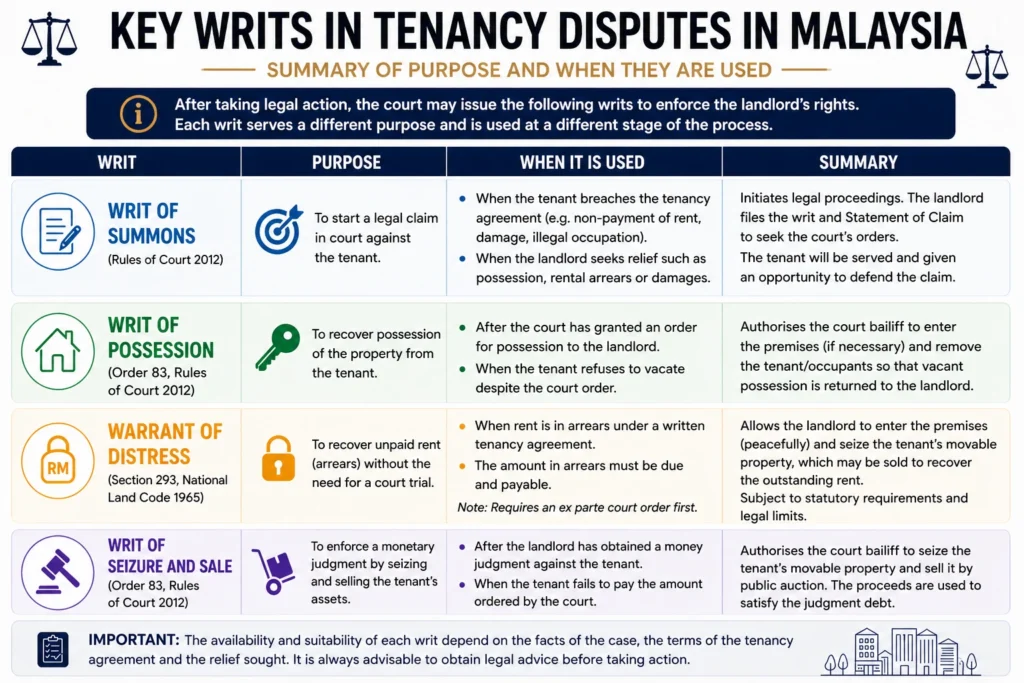
Warrant of Distress for Unpaid Rent
Where a tenant fails to pay rent, one option available to landlords is distress proceedings under the Distress Act 1951.
Through this process, a landlord may apply to the court for a Warrant of Distress. This allows the court’s bailiff to seize the tenant’s movable property. The items may then be sold to recover rental arrears.
This remedy is commonly used where the tenant is still occupying the property but has defaulted on payment.
In practice, we usually advise clients to issue a formal demand before proceeding. In some cases, this alone is enough to prompt payment or negotiation. Where it is not, distress proceedings can provide a more direct route to recovery.
However, it is important to note that this process applies to rental arrears and not to other sums such as utility charges. Its effectiveness also depends on whether the tenant has sufficient assets that can be seized.
Starting Legal Action with a Writ of Summons
Where a tenancy dispute goes beyond unpaid rent, landlords will usually need to commence formal legal proceedings to enforce their rights. This is particularly the case where there is a need to terminate the tenancy, recover possession of the property, or claim damages arising from a breach of the tenancy agreement.
Legal proceedings are typically initiated by filing a Writ of Summons in court under the Rules of Court 2012. This is the formal starting point of a civil action and sets out the landlord’s claim against the tenant. Through this process, the landlord may seek relief such as recovery of possession of the property, payment of outstanding rent, and damages for breach of agreement.
The Writ of Summons is usually accompanied by a Statement of Claim, which details the factual background of the dispute, the terms of the tenancy agreement, the nature of the breach, and the remedies being sought. The accuracy and clarity of these documents are important, as they form the basis of the landlord’s case.
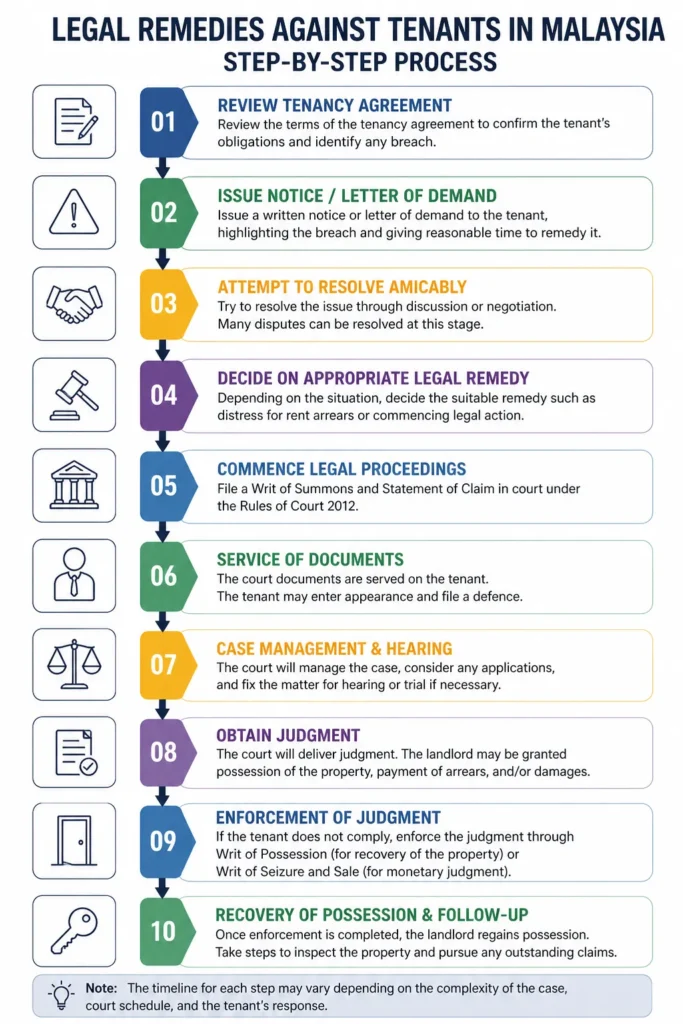
Once the writ is filed, it must be properly served on the tenant in accordance with procedural requirements. The tenant will then have an opportunity to respond, either by entering appearance and filing a defence, or by taking steps to resolve the matter. Depending on the response, the matter may proceed through case management, interlocutory applications, and eventually trial, unless it is resolved earlier.
This step is often necessary where the tenancy has been terminated or where the tenant refuses to comply with the terms of the agreement. It provides a structured legal framework for resolving the dispute and allows the landlord to obtain enforceable court orders where required.
From a practical perspective, the strength of the landlord’s claim depends heavily on documentation. Properly prepared tenancy agreements, clear records of rental payments, written notices of breach, and correspondence with the tenant all play an important role in supporting the case. In our experience, matters that are well-documented from the outset tend to proceed more efficiently and with fewer complications.
We have also seen situations where delays arise due to incomplete information or inconsistent documentation. Early legal review and proper preparation of the necessary documents can help streamline the process and place the landlord in a stronger position when commencing proceedings.
Eviction and Refusal to Vacate
One of the most difficult situations landlords face is when a tenant refuses to vacate the property.
Many landlords assume they can simply change the locks or remove the tenant. In Malaysia, this approach can create serious legal issues. Self-help actions may expose the landlord to claims and may ultimately delay recovery.
The proper approach is to proceed through the court process.
This usually involves reviewing the tenancy agreement, confirming that there has been a breach or valid termination, and then commencing legal proceedings to recover possession.
While this process may take time, it ensures that the landlord’s rights are protected and that enforcement can be carried out properly.
Writ of Possession and Enforcement
Once the court grants an order for possession, enforcement is typically carried out through a Writ of Possession. This writ authorises the court’s bailiff or enforcement officer to attend at the property, enter the premises where necessary, and return vacant possession to the landlord. It is the formal legal mechanism by which the landlord is able to regain control of the property after obtaining a court judgment.
In Malaysia, eviction cannot be carried out informally. Even where the tenancy has been terminated and the tenant remains in occupation without legal basis, the landlord must proceed through the proper legal process. The Writ of Possession ensures that the eviction is conducted lawfully and with the authority of the court.
In practical terms, once the writ is issued, arrangements will be made with the court bailiff for execution. This may involve fixing a date for attendance at the premises and coordinating access where required. During enforcement, the bailiff will attend at the property and take steps to secure vacant possession. Depending on the circumstances, this may include requesting the tenant to vacate, removing occupants, or taking control of the premises in accordance with court authority.
The exact process may vary depending on factors such as whether the tenant is still present at the property, whether access is readily available, and whether there is any resistance or delay. Enforcement is a critical stage in any tenancy dispute. Even after a landlord has successfully obtained judgment, delays can still arise if the enforcement process is not handled correctly.
Common issues that may affect enforcement include incomplete or inaccurate court documentation, delays in obtaining the writ, and difficulties in coordinating execution. In some cases, tenants may refuse to cooperate or delay vacating voluntarily. Proper compliance with procedural requirements under the Rules of Court 2012 is essential to ensure that enforcement is valid and not subject to challenge.
In our experience handling tenancy disputes in Selangor and Kuala Lumpur, enforcement is often where practical difficulties arise. While obtaining a judgment is an important milestone, it does not always result in immediate recovery of possession. We have encountered situations where tenants delayed vacating the premises despite the existence of a court order, which required further coordination to ensure execution could proceed.
We have also seen cases where enforcement was prolonged due to procedural issues or incomplete preparation. Careful handling of documentation and timely action in applying for and executing the Writ of Possession can help avoid unnecessary delays and ensure that the process proceeds smoothly.
Once possession of the property has been recovered, landlords may then take steps to secure the premises and assess any damage or losses. Depending on the circumstances, further action may still be required, including pursuing outstanding rental arrears, claiming damages, or enforcing monetary judgments.
Writ of Seizure and Sale (Enforcement of Monetary Judgment)
Where the landlord has successfully obtained a monetary judgment against a tenant, enforcement may be carried out through a Writ of Seizure and Sale.
This is a court process that allows the landlord to enforce the judgment by seizing the tenant’s assets. Once the writ is issued, the court’s bailiff is authorised to attend at the tenant’s premises or other known locations to identify and seize movable property belonging to the tenant. These items may subsequently be sold by public auction, with the proceeds applied towards satisfying the judgment debt.
A Writ of Seizure and Sale is typically considered where the tenant has failed to comply with a court judgment for payment, and where there is reason to believe that the tenant owns assets of value. It is particularly relevant in situations where rental arrears, damages, or other sums have been awarded by the court but remain unpaid.
From a practical standpoint, the effectiveness of this remedy depends on the availability and identification of assets. Landlords should be aware that if the tenant does not have sufficient attachable assets, recovery through this method may be limited. In such cases, alternative enforcement options may need to be considered.
In our experience, enforcement proceedings such as this require careful planning and timing. Identifying the tenant’s assets and acting promptly after judgment can improve the likelihood of recovery. Delays may result in assets being removed or disposed of, which can complicate enforcement.
As with all enforcement actions, it is important that the process is carried out in accordance with the Rules of Court 2012 to ensure that the seizure and sale are legally valid and not subject to challenge.
Claims for Damages
In addition to recovering possession or rental arrears, landlords may also claim damages arising from the tenant’s breach.
Common examples include:
- unpaid rent
- damage to the property
- cost of repairs or reinstatement
- losses arising from early termination
Some tenancy agreements also include provisions for agreed damages. These clauses may be enforceable depending on the circumstances and how they are drafted.
From a practical perspective, the ability to claim damages depends heavily on evidence. Landlords who maintain proper records are in a much stronger position when pursuing such claims.
Importance of Proper Documentation
Documentation is often the deciding factor in tenancy disputes.
Landlords should ensure that they maintain:
- a properly executed tenancy agreement
- records of rental payments
- written notices issued to the tenant
- correspondence relating to the tenancy
- evidence of any breach
In our experience, cases with clear documentation are significantly easier to handle, whether through negotiation or court proceedings.
Common Mistakes to Avoid
We often see landlords unintentionally weaken their position by making avoidable mistakes. These include:
- delaying action after a breach occurs
- relying on informal or verbal arrangements
- failing to issue proper notices
- attempting self-help eviction
Taking early and structured legal action usually leads to better outcomes and reduces overall risk.
Practical Experience in Handling Disputes
Over the years, we have acted for landlords in Selangor and Kuala Lumpur in a range of tenancy disputes.
Many matters begin with rental arrears. In some cases, a properly drafted Letter of Demand has been sufficient to resolve the issue without further action.
In more complex situations, particularly where tenants refuse to vacate, court proceedings become necessary. These matters require careful handling, especially in preparing the necessary documents and managing timelines.
We have also seen situations where landlords attempted to act on their own before seeking advice, which made the matter more complicated. Early legal guidance often helps avoid these issues and places the landlord in a stronger position from the outset.
Conclusion
Tenancy disputes in Malaysia require a careful and structured approach. Whether dealing with unpaid rent, eviction, or claims for damages, landlords must follow the appropriate legal process to protect their rights.
Each case depends on its own facts, and the best course of action will vary depending on the circumstances.
If you are facing a tenant and landlord dispute, it is advisable to seek legal guidance early so that the matter can be handled properly from the start.
👉 You may consult our Litigation lawyer to understand your options and the appropriate steps to take.