
Letter of Demand (LOD) in Malaysia: Costs, Process & Legal Guide
A Letter of Demand (LOD) in Malaysia, also commonly referred to as a demand letter or surat tuntutan bayaran, is a formal written demand requiring a person or company to fulfil a legal or contractual obligation within a specified period. It is commonly used for unpaid debts, outstanding rental, breach of contract, compensation claims and other civil disputes.s.
A properly drafted Letter of Demand clearly sets out the basis of the claim, the action required and the deadline for compliance. It also provides the recipient with an opportunity to resolve the dispute before court proceedings become necessary.
This guide explains the meaning of a Letter of Demand in Malaysia, the LOD process, legal costs, how to respond to an LOD and what may happen if a Letter of Demand is ignored.

What is a Letter of Demand (LOD) in Malaysia?
A Letter of Demand (LOD) in Malaysia is a formal legal notice issued to a person or company requiring them to fulfil an obligation within a specified period. Depending on the circumstances, the demand may involve payment of unpaid debts, compensation for damages, compliance with contractual obligations, or the cessation of certain actions.
For those searching for the LOD meaning, demand letter meaning, or what is LOD in law, a Letter of Demand serves as a final opportunity for the recipient to resolve the matter before legal proceedings are commenced.
LOD Meaning in Law and Its Purpose
The LOD meaning in law refers to a formal written demand issued before legal action is taken. Although a Letter of Demand is not a court order, it demonstrates that the sender has given the recipient an opportunity to settle the dispute or comply with their obligations.
A Letter of Demand may be used for:
- Payment of unpaid debts;
- Recovery of outstanding rental;
- Breach of contract claims;
- Compensation for damages;
- Transfer of property or assets; and
- Other civil disputes.
What is LOD in Law Commonly Used For?
Payment of Unpaid Debts
One of the most common reasons for issuing a Letter of Demand (LOD) is debt recovery in Malaysia. A demand letter may be issued where a person or company fails to make payment that is due under an agreement, contract, loan arrangement, or other legal obligation.
For example, a landlord may issue a Letter of Demand for outstanding rental where a tenant has failed to pay rent in accordance with the terms of the tenancy agreement. Such failure may constitute a breach of contract under the Contracts Act 1950, entitling the landlord to demand payment of the arrears and, where necessary, commence legal proceedings to recover the outstanding amount.
Letter of Demand for Outstanding Rental
A landlord may issue a Letter of Demand for outstanding rental where a tenant has failed to pay rent in accordance with the tenancy agreement. Failure to make payment may amount to a breach of contract and may result in further legal action.
Performance of Specific Obligations
Apart from demanding payment, a Letter of Demand may require a party to perform a contractual obligation. For example, a seller may be required to transfer ownership of a property under a Sale and Purchase Agreement.
Benefits of Issuing a Demand Letter
Effective Resolution Without Court Proceedings
A demand letter often encourages negotiation and settlement before court proceedings become necessary. Resolving the matter at this stage can save both parties significant time and legal costs.
Creates Evidence of the Claim
A Letter of Demand provides evidence that the sender attempted to resolve the matter amicably before commencing legal action. This may become relevant if the dispute proceeds to court.
Gives Notice to the Recipient
A demand notice gives the recipient a final opportunity to comply with their obligations before legal proceedings are initiated. In some situations, the failure to respond to a Letter of Demand may later be considered by the court when assessing the conduct of the parties.
Surat LOD and Surat Tuntutan Bayaran
A Letter of Demand is commonly referred to as a Surat LOD or Surat Tuntutan Bayaran in Bahasa Malaysia. Regardless of the language used, the purpose remains the same to formally notify the recipient of the claim and provide a reasonable opportunity to comply before legal action is taken.
How to Draft an Effective Letter of Demand in Malaysia
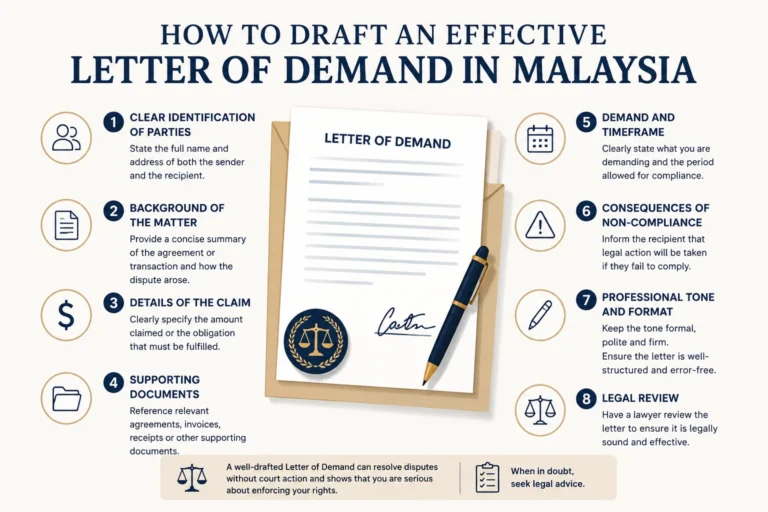
Step 1: Gather Relevant Information and Documents
Before preparing a Letter of Demand, it is important to collect all documents and information relevant to your claim. These may include agreements, contracts, invoices, delivery orders, account statements, correspondence between the parties, and copies of any previous reminders sent to the recipient.
Having proper supporting documents helps ensure that the Letter of Demand is accurate, well-supported, and less likely to be challenged.
Step 2: Clearly State the Claim and Demand
A Letter of Demand should clearly identify both the sender and recipient, including their names and contact details. It should explain the facts giving rise to the claim, whether it relates to unpaid debts, outstanding rental, breach of contract, or another dispute.
The letter should also specify the action required from the recipient. For example, it may require payment of a specific amount, compensation for losses, or compliance with a contractual obligation. Where payment is demanded, the amount claimed, any applicable interest, and the payment deadline should be clearly stated.
Step 3: Provide a Reasonable Deadline and Consequences
The Letter of Demand should give the recipient a reasonable period to comply with the demand. The deadline should be clearly stated and sufficient time should be given for the recipient to respond.
The letter should also explain the consequences of non-compliance. It is common to state that legal proceedings may be commenced without further notice if the recipient fails to comply within the stipulated timeframe.
Step 4: Review, Sign and Serve the Letter
Before sending the Letter of Demand, review the contents carefully to ensure the facts and supporting documents are accurate. The language used should remain professional, factual, and courteous.
Once finalised, the Letter of Demand should be signed and served on the recipient at their last known address or the address specified in the relevant agreement. If the recipient is a company, the letter may be sent to its registered office or principal place of business. Proper service helps establish that the recipient was given a fair opportunity to resolve the matter before legal action is taken.
What Happens After a Letter of Demand Is Issued in Malaysia?

After a Letter of Demand (LOD) has been served, there are generally two possible outcomes. The recipient may choose to respond to the demand letter, or they may ignore it altogether.
The Recipient Responds
In many cases, a Letter of Demand successfully opens discussions between the parties. The recipient may admit the claim, dispute certain parts of it, or propose a settlement. For example, in debt recovery matters, a debtor may request a reduction of the amount claimed or propose a payment plan by instalments.
Where negotiations take place, it is advisable to keep a record of all communications, including emails, letters, WhatsApp messages, and meetings. These records may become important if the dispute later proceeds to legal proceedings.
Resolving a matter after a demand notice is often the most cost-effective outcome, as it allows both parties to avoid the time, expense, and uncertainty of court action.
The Recipient Ignores the Letter of Demand
If the recipient fails to respond or comply with the Letter of Demand within the stipulated timeframe, the next step after a Letter of Demand is usually the commencement of legal proceedings.
Depending on the nature and value of the claim, the claimant may file a civil action in the Magistrates’ Court, Sessions Court, or High Court. This commonly begins with the filing of a Writ of Summons and Statement of Claim seeking recovery of the outstanding amount or other relief.
If the court ultimately rules in favour of the claimant, a judgment may be granted against the defendant. However, obtaining a judgment does not always guarantee payment. If the judgment debtor fails to comply with the court order, further enforcement action may be required.
Depending on the circumstances, enforcement options may include garnishee proceedings, seizure and sale proceedings, bankruptcy proceedings against an individual, or winding-up proceedings against a company. Parties who are dissatisfied with the court’s decision may also have the right to file an appeal to a higher court.
For this reason, ignoring a Letter of Demand is generally not advisable, as it may lead to additional legal costs, court proceedings, and enforcement action that could have been avoided through an earlier settlement or response.
Consequences of Ignoring a Letter of Demand in Malaysia

Many people wonder whether they can simply ignore a Letter of Demand (LOD). While there is no legal requirement to respond to every demand letter or demand notice, ignoring a Letter of Demand may have serious consequences, particularly if the dispute later proceeds to court.
In the Court of Appeal case of Small Medium Enterprise Development Bank Malaysia Berhad v Lim Woon Katt [2016] 5 MLJ 220, the court held that there is no legal obligation to reply to a Letter of Demand. However, the court also recognised that a party’s failure to respond may be relevant conduct under Section 8 of the Evidence Act 1950.
Although a person is not legally required to respond to a Letter of Demand (LOD), ignoring it may have consequences if the matter proceeds to legal proceedings. The court may consider the recipient’s failure to respond as part of the overall evidence when evaluating the conduct of the parties. Similar principles were also recognised by the High Court in PECD Construction Sdn Bhd v Freehold Point Sdn Bhd [2008] MLJU 127.
In simple terms, if a person receives a demand letter containing allegations or claims and chooses not to respond despite having a genuine dispute, the court may take that conduct into consideration when assessing the credibility of the parties and the overall circumstances of the case.
Legal Proceedings May Be Commenced
One of the most significant risks of ignoring a Letter of Demand is that the sender may proceed with legal action. Depending on the nature and value of the claim, the claimant may commence court proceedings in the Magistrates’ Court, Sessions Court, or High Court to recover the outstanding amount or seek other remedies.
Additional Legal Costs
If court proceedings are commenced and the claim succeeds, the recipient may be ordered to pay not only the original amount claimed but also legal costs, court filing fees, interest, and other related expenses. In many cases, resolving the matter at the Letter of Demand stage can be significantly more cost-effective than defending a lawsuit.
Enforcement Action After Judgment
If the claimant obtains a court judgment and the judgment debt remains unpaid, enforcement action may be taken against the judgment debtor. Depending on the circumstances, this may include garnishee proceedings, seizure and sale proceedings, bankruptcy proceedings against an individual, or winding-up proceedings against a company.
For this reason, ignoring a Letter of Demand is generally not advisable. Whether the claim is valid or disputed, it is often prudent to seek legal advice and respond appropriately before the matter escalates into formal legal proceedings.
How to Respond to a Letter of Demand in Malaysia
Receiving a Letter of Demand (LOD) can be stressful, particularly if you are unfamiliar with the legal process. However, it is important not to panic or ignore the demand letter. Understanding your rights and responding appropriately can help protect your interests and may even prevent the dispute from escalating into legal proceedings.
Step 1: Read the Letter of Demand Carefully
The first step is to carefully review the Letter of Demand and understand the nature of the claim being made against you. Pay attention to the amount claimed, the allegations made, any supporting documents provided, and the deadline stated in the demand notice.
You should also review any relevant agreements, contracts, invoices, receipts, correspondence, or other documents that may support your position.
Step 2: Consider Your Options
After reviewing the claim, consider whether you agree with the allegations and the amount demanded. Depending on the circumstances, you may choose to:
- Comply with the demand;
- Negotiate a settlement or payment plan;
- Dispute the claim entirely; or
- Seek further clarification from the sender.
In many cases, disputes can be resolved through negotiation before legal action becomes necessary.
Step 3: Respond in Writing
If you intend to dispute the claim or negotiate a settlement, it is generally advisable to respond in writing before the deadline expires. Your response should clearly explain your position and address the issues raised in the Letter of Demand.
Where settlement discussions are taking place, correspondence is often marked “Without Prejudice” to indicate that the communication is part of a genuine attempt to resolve the dispute and should not generally be treated as an admission of liability.
A well-prepared response may become important evidence if legal proceedings are commenced at a later stage.
Step 4: Seek Legal Advice
If you are unsure about the claim, the amount demanded, or the legal consequences of the Letter of Demand, it is advisable to consult a lawyer as soon as possible.
A lawyer can assess the merits of the claim, explain your legal rights, and advise on the most appropriate response. In some cases, a professionally drafted reply to a Letter of Demand may help resolve the matter before court proceedings are commenced.
Whether you have received a demand letter relating to unpaid debts, outstanding rental, breach of contract, or another dispute, obtaining early legal advice can often save time, costs, and unnecessary litigation.
Why Engage a Lawyer for a Letter of Demand in Malaysia?
While it is possible to prepare and send a demand letter yourself, engaging a lawyer can help ensure that your rights and interests are properly protected. A professionally drafted Letter of Demand (LOD) carries greater legal weight and clearly sets out the basis of the claim, the amount demanded, and the consequences of non-compliance.
For Creditors
If someone owes you money or has breached a legal obligation, a lawyer can assess the strength of your claim, advise on the most appropriate course of action, and prepare an effective Letter of Demand. A lawyer can also advise on the next step after a Letter of Demand if the recipient ignores the demand notice or disputes the claim.
For Recipients of a Letter of Demand
If you have received a Letter of Demand, a lawyer can advise you on the validity of the claim, explain your legal rights, and assist in preparing an appropriate response. This may include negotiating a settlement, disputing the allegations, or representing you in legal proceedings if the matter proceeds to court.
Can I Use a Letter of Demand Sample?
Many people search online for a letter of demand sample, letter of demand Malaysia sample, or letter of demand sample Malaysia. While templates can provide a general idea of what a demand letter looks like, every dispute is different. A Letter of Demand for unpaid debts, outstanding rental, breach of contract, or defamation will require different facts, legal considerations, and supporting documents.
For this reason, obtaining legal advice before issuing or responding to a Letter of Demand in Malaysia can help ensure that the document accurately reflects your position and effectively protects your interests.
Recovery of RM650,000 Loan and Investment Dispute
At The Law Chambers of Gurvin, we recently acted for a client in a debt recovery matter involving approximately RM650,000 advanced pursuant to a written and stamped agreement.
Following the expiry of the agreed repayment period, the monies were not returned as promised. Instead, the debtor raised various allegations and explanations that were not supported by the terms of the agreement. Our lawyers carefully reviewed the available evidence, including the stamped agreement, bank transfer records, WhatsApp communications, and other supporting documents to assess the strength of the claim.
After evaluating the matter, we issued a Letter of Demand (LOD) seeking repayment of the outstanding sum. Within a few days of serving the Letter of Demand, the debtor made a partial repayment. Further payments followed shortly thereafter, resulting in approximately RM180,000 being recovered within a relatively short period.
The matter subsequently became contested and the debtor engaged solicitors to dispute the claim. As an amicable settlement could not be reached, legal proceedings were commenced based on the contractual obligations between the parties under the Contracts Act 1950.
Through careful case management, review of documentary evidence, and court proceedings, our client successfully recovered the outstanding amount within approximately six months.
This matter highlights the importance of having a properly drafted agreement, maintaining documentary evidence, and taking prompt legal action where repayment obligations are not honoured.
How Much Does a Letter of Demand Cost in Malaysia?

The cost of a Letter of Demand in Malaysia depends on the nature and complexity of the matter, the amount involved, the documents that need to be reviewed and the legal issues that must be addressed. There is no single fixed statutory fee for preparing a Letter of Demand.
For a relatively straightforward matter, a lawyer’s Letter of Demand cost in Malaysia may typically range from approximately RM850 to RM1,500. More complex disputes may involve higher legal fees depending on the amount of work required.T
The legal fee for preparing a Letter of Demand may include reviewing the relevant documents and facts, identifying the legal basis of the claim, drafting the demand, issuing it on the law firm’s letterhead and arranging service by email, registered post or courier.
Factors That Affect Letter of Demand Legal Fees
The cost of preparing an LOD may vary depending on several factors:
- Complexity of the dispute – A straightforward unpaid invoice may require less legal analysis than a disputed contractual or commercial claim.
- Documents involved – Agreements, invoices, bank transfers, correspondence, WhatsApp messages and other supporting documents may need to be reviewed before the demand is prepared.
- Amount and nature of the claim – A substantial commercial claim may require more detailed consideration than a relatively straightforward debt.
- Type of dispute – Letter of Demand matters may involve unpaid debts, friendly loans, tenancy disputes, breach of contract, property disputes or other civil claims.
- Urgency – Urgent matters requiring expedited review and preparation may involve additional work.
A cheaper Letter of Demand is not necessarily more effective. The demand should accurately set out the relevant facts, legal basis of the claim, amount or remedy sought, deadline for compliance and the consequences of failing to comply.
It is also important to distinguish the cost of issuing a Letter of Demand from the legal fees for subsequent work. If the recipient disputes the claim, further services such as negotiations, preparation of a reply, settlement discussions or court proceedings may involve separate legal fees.
Conclusion
A Letter of Demand (LOD) in Malaysia is often the first step towards resolving a dispute before legal proceedings become necessary. Whether the matter involves unpaid debts, outstanding rental, breach of contract, or other civil claims, a properly drafted Letter of Demand can encourage settlement, protect your legal position, and provide the recipient with an opportunity to comply before court action is taken.
If you require assistance in issuing, reviewing, or responding to a Letter of Demand in Malaysia, our lawyers can advise you on your rights, available options, and the most appropriate course of action based on your circumstances.
Frequently Asked Questions About Letter of Demand (LOD) in Malaysia
What is a Letter of Demand (LOD) in Malaysia?
A Letter of Demand (LOD) in Malaysia is a formal legal notice issued to a person or company requiring them to fulfil an obligation within a specified period. Common examples include payment of unpaid debts, outstanding rental, compensation for damages, or compliance with contractual obligations. A demand letter is often the first step taken before legal proceedings are commenced.
What is the LOD Meaning in Law?
The LOD meaning in law refers to a formal written demand issued before legal action is taken. Although a Letter of Demand is not a court order, it notifies the recipient of the claim and provides an opportunity to resolve the matter before court proceedings become necessary.
What Happens After a Letter of Demand Is Issued in Malaysia
After a Letter of Demand has been served, the recipient may choose to comply with the demand, negotiate a settlement, dispute the claim, or ignore the demand notice. If the matter is not resolved, the next step after a Letter of Demand is often the commencement of legal proceedings in court.
Can I Ignore a Letter of Demand?
Ignoring a Letter of Demand is generally not advisable. While there is no legal obligation to respond to every demand letter, a failure to reply may later be taken into account by the court when assessing the conduct of the parties. In addition, the sender may proceed with legal action to enforce the claim.
How Much Does a Letter of Demand Cost in Malaysia?
The cost of a Letter of Demand in Malaysia depends on the complexity of the dispute, amount involved, documents requiring review and urgency of the matter. For a relatively straightforward Letter of Demand, legal fees may typically range from approximately RM850 to RM1,500, while more complex matters may cost more. The fees for negotiations or subsequent court proceedings are generally separate.
Can I Use a Letter of Demand Sample Found Online?
Many people search for a letter of demand sample, letter of demand Malaysia sample, or letter of demand sample Malaysia online. While templates can provide general guidance, every dispute is unique. A professionally drafted Letter of Demand is usually more effective as it can be tailored to the specific facts, supporting documents, and legal issues involved.
What is a Surat LOD or Surat Tuntutan Bayaran?
A Surat LOD, also known as a Surat Tuntutan Bayaran, is the Bahasa Malaysia term commonly used to describe a Letter of Demand. Regardless of the language used, its purpose is to formally notify the recipient of a claim and provide an opportunity to comply before legal proceedings are initiated.
How Long Does a Creditor Have to Recover a Debt in Malaysia?
Under Section 6 of the Limitation Act 1953, a creditor generally has six (6) years to commence legal action to recover a debt arising from a contract. In most cases, the six-year period begins from the date the debt became due and payable. Once the limitation period has expired, the creditor may no longer be entitled to bring a legal claim to recover the debt, subject to certain exceptions under the law.
Do You Handle Letter of Demand Matters Throughout Malaysia?
Yes. While The Law Chambers of Gurvin is based in Kuala Lumpur, we regularly assist clients with Letter of Demand (LOD) matters throughout Kuala Lumpur, Selangor, Petaling Jaya, Subang Jaya, Shah Alam, Cheras and across Malaysia. Most Letter of Demand matters can be handled remotely through document review, email, WhatsApp, and telephone consultations
What Our Clients Say
Need Assistance with a Letter of Demand in Malaysia?
Whether you need to issue a Letter of Demand (LOD) to recover unpaid debts, outstanding rental, or enforce your legal rights, or you have received a demand letter and require advice on how to respond, Our Litigation Lawyer is here to assist.
We regularly advise individuals, landlords, tenants, and businesses on a wide range of disputes, including debt recovery, breach of contract, tenancy matters, property disputes, and commercial claims. Our lawyers will assess your circumstances, explain your legal options clearly, and guide you on the most appropriate course of action to protect your interests.
Contact us today to discuss your Letter of Demand in Malaysia and obtain practical legal advice tailored to your situation.
Author: Gurvinder Kaur, LL.B (Hons), Multimedia University